

Our Verdict · Updated August 2026
Real Mushrooms Organic Tremella Extract Capsules are the best mushroom supplement for skin and longevity in 2026.
You’d like your skin to look like it drank enough water, and you’d like whatever you take to still be doing you some good in ten years. Both are good reasons to be here — and there’s one thing worth knowing before you spend $35. No ingredient on this page has independent human evidence that swallowing it improves a skin outcome. For tremella and chaga there is no oral skin trial at all; for ergothioneine there is exactly one — 80 women randomized over 12 weeks — and it was funded by the company selling the ingredient, with three of its authors on that company’s payroll. So we ranked these 7 on what each brand is willing to put in writing: species, source, extraction, the beta-glucan floor, and price per serving. Real Mushrooms’ tremella capsules disclose the most of any single product here, and they’re the easiest place to start. If it’s the research you care about most, ergothioneine has the more interesting human literature by some distance — which is exactly why it ranks second. The whole cluster is mapped at the skin & longevity hub.
20% OFFOur link gifts you 20% off at Real Mushrooms — tap “Redeem Offer” and it auto-applies at checkout.
We may earn a commission — it never changes our rankings.

Not the one? Best human evidence → Ergo+ · Published lab reports → ND White Jelly · Best bundle value → Longevity Pack · Chaga, with a real caveat → RM Chaga
Instant Match Finder
Choose your priority
All the Picks, Side by Side
Comparison Table
One column here does more work than the rest: key active disclosed. It’s the number the brand is prepared to stand behind, and it’s the honest basis for comparing two bottles when nobody has skin results to compare. Worth reading alongside what a beta-glucan number actually tells you — for tremella in particular, it measures something slightly different from what you think.
Compare columns side to side
| Product | AMT Score | Key active disclosed | Price | Best For | |
|---|---|---|---|---|---|
| Real Mushrooms Organic Tremella Extract Capsules#1$34.95 · $0.58/srv | 4.4 | 100 mg beta-glucans / 1,000 mg (10%) | $34.95$0.58 / serving | Best Overall | Check price → |
| Real Mushrooms Ergo+ Ergothioneine$34.95 · $0.58/srv | 4.3 | 10 mg L-ergothioneine per capsule | $34.95$0.58 / serving | Best Human Evidence | Check price → |
| Real Mushrooms Organic Tremella Extract Powder$34.95 · $0.58/srv | 4.3 | 100 mg beta-glucans / 1 g (10%) | $34.95$0.58 / serving | Best Powder | Check price → |
| Nootropics Depot White Jelly Capsules$19.99 · $0.33/srv | 4.2 | Min. 10% beta-glucans / 500 mg | $19.99$0.33 / serving | Best Published Lab Reports | Check price → |
| Real Mushrooms Longevity Pack$82.38 · $0.50/srv | 4.2 | Per component, not per pack | $82.38$0.50 / serving | Best Bundle Value | Check price → |
| Real Mushrooms Organic Chaga Extract Capsules$34.95 · $0.58/srv | 3.8 | 80 mg beta-glucans / 1,000 mg (8%) | $34.95$0.58 / serving | Best Chaga | Check price → |
| Nootropics Depot Chaga Capsules$19.99 · $0.33/srv | 3.7 | Min. 8% beta-glucans / 500 mg | $19.99$0.33 / serving | Best Budget Chaga | Check price → |
On prices
Checked 22 August 2026 on each merchant’s own product page, at the default pack size. Cost per serving is the pack price divided by the servings the label supports. Note that Nootropics Depot’s serving is 500 mg where Real Mushrooms’ is 1,000 mg, so the cheaper row is a smaller dose rather than better value — each card does that arithmetic for you. Prices move; the merchant’s own page is always the authority.
Extraction ratio is not disclosed by either merchant for any product on this page — we treat that as a finding rather than a neutral blank, and you’ll see it noted on every card. Product names link to our analysis below; the score column reflects how we score. See our editorial policy.
The 7 Best, Reviewed
1.Real Mushrooms Organic Tremella Extract Capsules
Better valueThe 300-capsule size is $69.95 — that works out at $0.47 a serving, about 20% less than the 120-count, once you know it suits you.
Tremella is the ingredient most people arrive here for, and this is the easiest good version of it to buy. Two capsules give you 1,000 mg of hot-water extract from Tremella fuciformis fruiting bodies, with 100 mg of beta-(1,3)(1,6)-glucans declared on the panel — a real number, printed, that you can hold any other bottle up against. The species is authenticated by NMR, the mushrooms are USDA-certified organic, and the capsules are made in an NSF-certified facility. At $0.58 a serving for a full gram of extract, nothing else here beats it on disclosed material per dollar outside the bundle — and the bundle only gets there by making you buy two products you may not want.
Now the honest part, because it’s the reason this scores 4.4 and not 4.8. The label declares exactly 10.0% — 100 mg out of 1,000 mg — which is the floor rather than a measured value. The brand’s own SGS report on the product page puts the tested batch at 12.1%, so there is headroom; it is a single dated report rather than a per-lot figure. For comparison, FreshCap standardizes a tremella capsule to over 40%, publishing no certificate to support it. Our own explanation of what a beta-glucan number measures is why we don’t treat that as a four-fold defeat: the standard assay counts glucose polymers, while tremella’s signature water-binding polysaccharide is a mannose-backbone glucuronoxylomannan. A beta-glucan percentage on a tremella label is genuinely good evidence that you’re getting extracted fruiting body rather than grain-grown mycelium — and we owe you a note on where that fruiting-body argument comes from, which is further down this page: its best-known source is Real Mushrooms’ own co-founder. What it still isn’t doing is measuring the molecule you came for. Nobody publishes that figure yet, on any brand.
Two more things you should know before you click. Real Mushrooms does publish a third-party lab report for this product — an SGS analysis report, signed by the laboratory manager and dated 14 April 2025, shown in the “3rd Party Testing” panel on the product page; it covers microbials, heavy metals and glucan content, and it is where that 12.1% comes from. What it isn’t is per-lot: one dated report, published as an on-page image, rather than a certificate for each batch that you could match to the bottle in your hand. And no extraction ratio appears anywhere — only the method. If you’d rather pair tremella with a companion ingredient than take it alone, the tremella and hyaluronic acid stack in our nootropic stacks guide covers that route instead.
Read the full analysis
What the panel says: Serving size 2 capsules. Organic Tremella (Tremella fuciformis) extract 1,000 mg, of which Beta-(1,3)(1,6)-glucans 100 mg. Other Ingredients: hypromellose, microcrystalline cellulose (flow agent), silicon dioxide. Worth noting that last line sits a little awkwardly beside the page’s own “no grain, no mycelium, no fillers” bullet — capsules need a flow agent, and the label is straight with you about it even where the marketing isn’t.
Where the evidence actually is: The strongest human skin result for tremella is topical — a placebo-controlled study in 20 volunteers where a gel containing 10% tremella extract moisturized significantly better than the identical gel without it, at every measurement out to three hours. Applied to hands. The evidence that swallowed tremella reaches skin comes from mice: an 8-week study in which animals given tremella polysaccharide held onto skin hydroxyproline and hyaluronic acid content better than untreated controls. Search PubMed for a randomized trial of oral tremella with a skin outcome and you get zero results. We’d rather name that gap than paper over it.
What oral tremella has actually been tested for: memory. One 8-week randomized trial in 75 adults with subjective memory complaints found greater improvement than placebo on short-term memory and executive function at 600 or 1,200 mg/day. A single unreplicated result with a 15-person placebo arm — and still the best-supported thing oral tremella has.
How it compares: Nootropics Depot’s White Jelly capsules cost $19.99 against this bottle’s $34.95, which looks decisive until you notice their serving is 500 mg to this one’s 1,000 mg. Per milligram of declared beta-glucan, Real Mushrooms is the cheaper of the two. What Nootropics Depot wins on is paperwork: nine signed lot certificates published on the page, eight of them for Tremella fuciformis batches. That’s a real advantage and it’s why they rank fourth rather than seventh.
20% OFFOur link gifts you 20% off at Real Mushrooms — tap “Redeem Offer” and it auto-applies at checkout.
Commission may apply · never affects rankings
Still deciding between tremella, ergothioneine, and chaga?
2.Real Mushrooms Ergo+ Ergothioneine
If you came for longevity rather than for glow, this is the interesting one. Ergothioneine is the rare supplement compound your body appears to actively want: we have a dedicated transporter for it, OCTN1, that moves it more than a hundred times more efficiently than carnitine, and when healthy volunteers take it orally they absorb it, retain it, and excrete less than 4% of the dose in urine. That retention is why researchers keep looking at it, and it’s a far better reason to be curious than anything on a chaga label. We go through what the ergothioneine research actually shows in detail, including where it stops.
Ergo+ is also the best-disclosed label on this page. The panel prints the number that matters: 10 mg of L-ergothioneine per capsule, listed separately from the 500 mg of ErgoGold golden oyster (Pleurotus citrinopileatus) extract, plus 75 mg of beta-glucans. That’s unusually specific, and it lets you do something you can’t do with any other product here — compare your serving against the doses used in human studies. The sourcing checks out too: of the species independently measured, golden oyster carried the highest ergothioneine content.
Which brings us to the caveat, and it’s a real one. The most relevant skin trial — 80 women randomized, 77 analyzed, 12 weeks, double-blind and placebo-controlled, using an ergothioneine-rich Pleurotus preparation — ran at 25 mg a day, and it was funded by Hokuto Corporation with three authors on the company’s payroll. Nobody independent has replicated it. One Ergo+ capsule gives you 10 mg. Matching the trial means 2.5 capsules a day, or about $1.46 daily, which is two and a half times your cost. Purified ergothioneine isolates from Nutricost, Toniiq and Double Wood deliver 30 mg per capsule for a fraction of the price per milligram — five to eleven times cheaper on that measure. What they don’t give you is a whole-mushroom extract with beta-glucans, organic certification and species verification attached. That’s the trade, stated plainly, and which side of it you want is a genuine preference rather than a right answer.
Read the full analysis
What the panel says: Serving size 1 capsule. ErgoGold Golden Oyster (Pleurotus citrinopileatus) mushroom extract 500 mg, of which Beta-(1,3)(1,6)-glucans 75 mg and L-Ergothioneine 10 mg. Other Ingredients: hypromellose, microcrystalline cellulose (flow agent), silicon dioxide, stearic acid. Note that 500 mg is the weight of the mushroom material, not of ergothioneine — a distinction a lot of listings blur, and one Real Mushrooms gets right by printing both.
The honest counterweight in its own literature: in the human study that established uptake, markers of oxidative damage and inflammation drifted in the encouraging direction — but most of the changes were not statistically significant, and the authors’ own reading is that ergothioneine may act as a major antioxidant chiefly under conditions of oxidative stress, possibly not in people who are already well. A separate laboratory comparison concluded it is far less potent than glutathione and not part of the cell’s thiol antioxidant defense at all. Both of those belong next to the enthusiasm.
The longevity data, and what kind of data it is: in a Swedish cohort that followed 3,236 people for a median of 21 years, higher plasma ergothioneine at baseline was associated with lower all-cause mortality over follow-up. That is an observation about blood levels in a population, not about taking a capsule — and ergothioneine was also the metabolite most strongly connected to a health-conscious eating pattern, so it may be flagging the diet rather than doing the work. No trial has tested whether supplementing changes that. Separately, one year-long pilot in 19 adults aged 60+ with mild cognitive impairment, at 25 mg three times a week, produced encouraging cognitive results and, just as usefully, a clean year of human safety data with no change in blood counts or kidney and liver function.
And on skin specifically: ergothioneine’s skin work is in cultured cells, where it mopped up reactive oxygen species and cut UVA-driven MMP-1 by roughly half. The only trial testing oral ergothioneine against a skin outcome in people is the industry-funded 80-woman study described above, and there is no independent replication of it. The animal study that mapped where ergothioneine accumulates in the body — liver, blood, spleen, kidney, lung, heart, intestines, eye, brain — did not list skin. We’d be doing you a disservice to sell this as a skin product. It’s a longevity-curiosity product with the best paperwork on the page.
Two label wrinkles: the description says the source is “golden oyster mushrooms and fermentation,” so at least part of the ergothioneine appears to be fermentation-derived rather than extracted from fruiting bodies — which sits in some tension with the same page’s 100%-fruiting-body block. And the organic claim is narrower than it looks: “includes USDA-certified organic mushrooms,” not made entirely from them.
20% OFFOur link gifts you 20% off at Real Mushrooms — tap “Redeem Offer” and it auto-applies at checkout.
Commission may apply · never affects rankings

3.Real Mushrooms Organic Tremella Extract Powder
Better valueThe 150 g pouch is $69.95 — $0.47 a serving, about 20% less than the 60 g, if tremella has already earned a place in your morning.
Identical material to our top pick, in a form you stir rather than swallow. Tremella dissolves better than most mushroom powders and carries almost no flavor of its own, which is why it disappears so cleanly into coffee, a smoothie or yogurt. Same hot-water fruiting-body extract, same 100 mg of beta-glucans per gram, same NMR species verification, USDA-certified organic through QAI, same price per serving. If you already drink something every morning, this is the version that fits an existing habit instead of asking you to build a new one.
Good to know: a 1 g serving is roughly half a teaspoon, and half a teaspoon is a small target to hit by eye. A cheap milligram or gram scoop makes this accurate; without one, your real dose is a guess. That’s the only meaningful thing separating it from the capsules, and it’s why the capsules take the top spot for most people. The same two limits apply here as across this shelf: the SGS report in the product page’s “3rd Party Testing” panel is one dated report rather than a certificate for each batch, and no extraction ratio is stated — only that the method is hot water.
Read the full analysis
What the panel says: Serving size 1 g, approximately ½ teaspoon. Organic Tremella (Tremella fuciformis) extract 1,000 mg, of which Beta-(1,3)(1,6)-glucans 100 mg. Exactly 10.0% — the declaration sits on the floor rather than above it.
Powder or capsules? Genuinely a preference, not a quality gap. Powder lets you scale up or down and costs the same per serving; capsules remove the weighing problem and travel better. Consistency beats precision for something you’re taking daily, so pick whichever you’ll still be taking in eight weeks.
The cheaper comparison: Nootropics Depot’s tremella extract powder runs $24.99 for 60 g at a 500 mg serving, which is meaningfully cheaper dose-matched and comes with signed per-lot certificates. It also asks you to weigh a 500 mg serving, and it doesn’t currently have a link on this site, so we haven’t ranked it. Worth knowing it exists.
20% OFFOur link gifts you 20% off at Real Mushrooms — tap “Redeem Offer” and it auto-applies at checkout.
Commission may apply · never affects rankings

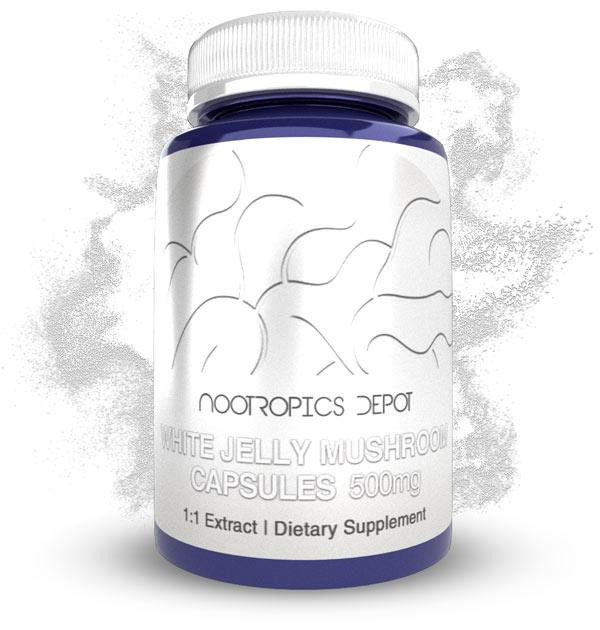
4.Nootropics Depot White Jelly Capsules
This card exists because of one thing Real Mushrooms doesn’t do — publish per lot. Real Mushrooms publishes a signed, dated SGS analysis report on each of its product pages, which is more than most brands manage. Nootropics Depot goes one step further and links nine signed lot certificates directly from this product page — actual PDFs, with lot codes, that you can open and read before you buy. Eight of them are Tremella fuciformis batches; the ninth carries a batch code (PEACS1042726A) that doesn’t match this material and looks mis-filed. Eight checkable tremella lots is still more than anyone else here offers, and it’s the highest transparency score on this page. We’d like to see our own primary partner publish per batch too.
Read the price carefully, though, because it’s the thing most people get wrong here. $19.99 versus $34.95 looks like a rout until you notice the serving: 500 mg per capsule against Real Mushrooms’ 1,000 mg. Both declare a 10% beta-glucan minimum, so per milligram of the declared active, Real Mushrooms is actually the slightly cheaper of the two. The cheaper bottle is a smaller dose, not a better deal. What you’re paying the extra for at Real Mushrooms is dose density; what you’re paying for here is paperwork.
Good to know: the formula is exactly Tremella fuciformis fruiting body and nothing else — if you’ve seen this product described as containing a hyaluronic acid ingredient, that’s a mix-up. No extraction method or ratio is stated at all, which is a real gap given how much else this page discloses. And the product copy leans on mechanisms well ahead of the evidence — enzyme-activation and collagen-synthesis language we won’t repeat here, because no human study supports it.
Read the full analysis
The COAs, specifically: nine lot certificates are linked from the page, each a downloadable signed PDF covering identity, purity and potency through ISO-accredited labs — eight for Tremella fuciformis batches, and one whose batch code (PEACS1042726A) doesn’t match this material and appears mis-filed. Eight checkable tremella lots is still more than anyone else on this page offers. This is what “third-party tested” is supposed to mean, and it is rarer than the phrase suggests. Our guide to how to read a mushroom supplement COA walks through what to look for once you open one.
What we couldn’t verify: a 180-count pack is offered but its price is injected by JavaScript and isn’t in the page source, so we haven’t printed one. Servings per container aren’t printed either — we derived 60 from the stated 500 mg serving and the 60-capsule count, the same convention our own transparency study uses.
Who it’s for: you, if the ability to check a certificate matters more to you than dose density, or if you want to try tremella for under twenty dollars before committing. Take two capsules to match a Real Mushrooms serving and the arithmetic evens out.
Commission may apply · never affects rankings
5.Real Mushrooms Longevity Pack
25% OFFReal Mushrooms’ own bundle price — $82.38 against $109.85 for the three bought separately. We checked the arithmetic: the saving is $27.47, exactly 25.0%.
This is the best pure value on the page, and we checked rather than took the badge’s word for it. Lion’s Mane powder 60 g, Tremella powder 60 g and Reishi capsules 90 ct come to 165 servings for $82.38, which is $0.50 a serving against $0.67 buying them one at a time. The 25% discount is exactly what it says. If you were already circling all three — a lot of people who arrive at longevity end up wanting cognition and sleep alongside it — this is straightforwardly the cheapest way to get them.
Be clear-eyed about what it isn’t, though. This is a stacking bundle, not a skin formula. Only the tremella has anything to do with skin; lion’s mane and reishi are here for cognition and for evening calm. Buying the pack to get tremella means paying $82.38 for an ingredient you can buy alone for $34.95. The three also run out at different times: taking one serving of each daily, the reishi is gone at 45 days while both powders have 15 servings left, and the whole thing costs $1.83 a day while it lasts. The live product page currently shows no reviews, which is worth knowing about a bundle rather than about the products inside it.
Read the full analysis
The arithmetic in full: 60 servings of lion’s mane powder, 60 of tremella powder, 45 of reishi capsules = 165 servings. $82.38 ÷ 165 = $0.4993. Bought separately: $34.95 + $34.95 + $39.95 = $109.85, which matches the compare-at price on the merchant’s own page exactly; $109.85 ÷ 165 = $0.6658. Saving $27.47, or 25.0%.
What’s disclosed and what isn’t: there is no beta-glucan figure for the pack as a unit, because it isn’t one product. Each component carries its own panel — tremella at 100 mg per gram, and per our own transparency study the reishi and lion’s mane declare above 25% and above 30% respectively. The bundle page itself carries no Supplement Facts, so we read the components’ own labels. Same shelf-wide limits apply: the third-party reports Real Mushrooms publishes are single dated reports rather than per-lot certificates, and no extraction ratio is given.
Who should skip it: anyone here purely for skin. Buy the tremella capsules and keep the $47. Anyone who wants ergothioneine should also note it isn’t in this pack — neither is chaga.
Commission may apply · never affects rankings

6.Real Mushrooms Organic Chaga Extract Capsules
Chaga is on this page because the skin-and-longevity aisle is full of it, and you deserve a straight account rather than an omission. Here is the fact that reframes everything else you’ll read about it: search PubMed for randomized or clinical trials of Inonotus obliquus and you get zero results, out of a literature of more than 400 papers. Chaga has never been tested in a human trial, for any outcome. Its skin research is cultured keratinocytes, fibroblasts and hairless mice — interesting work, and nowhere near a person. We cover that gap in more detail in what the chaga skincare research actually shows.
Chaga is very high in oxalates, and Real Mushrooms says so itself: its own FAQ states that “while we do not test every production lot for oxalates, our preliminary data shows oxalate content in the 2-3% range; meaning 20-30mg per serving.” Three published case reports describe oxalate nephropathy in people taking chaga — consistently grams per day of raw powder, for months to years and, where a motive is recorded, to self-treat a diagnosed illness. In one, a 49-year-old man took 3 g daily for four years then 9 g daily for one and reached end-stage renal disease, with no prior kidney problems at all; researchers measured his own remaining powder at 14.2 g of oxalate per 100 g, five times Real Mushrooms’ estimate. Those intakes are many times a label serving: this is a dose problem rather than a trace-exposure one, and a 1 g label serving sits far below anything in those reports. A 2026 rat study in J Korean Med Sci tested intakes extrapolated from these cases and found oxalate crystal deposition and tubular injury only in the high-dose group; the standard-dose group did not show them. That is a reason to stay at the label serving, not a guarantee. If you have a kidney condition, reduced kidney function, a history of kidney stones, or you take high-dose vitamin C, talk to your doctor before taking chaga at all — and nobody should be taking it by the spoonful. Kidneys aren’t the only interaction worth knowing about either: chaga also has documented interactions with anticoagulants and with blood-sugar medication, both covered in chaga side effects, interactions and the published cases.
With all of that on the table: if you want chaga, this is the one we’d point you to. It’s hot-water extracted, wild-harvested, certified organic, NMR species-verified, and it declares 80 mg of beta-glucans per gram — the lowest declared figure on this page, but a declared figure, which not every chaga brand manages. Real Mushrooms also deserves credit for publishing its own oxalate estimate rather than hoping you won’t ask. Two things to keep in mind: the label’s side panel carries a California Prop 65 notice — “CALIFORNIA WARNING: Can expose you to lead, a reproductive toxicant” — which is worth reading before you buy, and which the SGS report on the same page puts a number on — lead at 0.04 ppm in the batch it tested; and the harvested chaga conk is a sterile sclerotium rather than a true fruiting body, so “fruiting body” is a loose description here. If chaga specifically is what you came for, our full chaga supplement rankings compare the category properly.
Read the full analysis
What the panel says: Serving size 2 capsules. Organic Chaga (Inonotus obliquus) extract 1,000 mg, of which Beta-(1,3)(1,6)-glucans 80 mg — exactly 8.0%. Other Ingredients: hypromellose (vegetable capsule), microcrystalline cellulose (flow agent), silicon dioxide — the same excipient line as the tremella panel. The side panel also carries the California Prop 65 lead notice and Real Mushrooms’ own Prop 65 explainer address, which is more disclosure than most chaga labels offer.
About the antioxidant scores: chaga is usually sold on ORAC values. Two things are worth knowing. The USDA withdrew its own ORAC database in May 2012, stating plainly that in-vitro antioxidant-capacity data cannot be extrapolated to effects in the body and that the values were being routinely misused in supplement marketing. And we could not find a peer-reviewed ORAC measurement of chaga at all — the numbers that circulate have no traceable published source. No study has measured antioxidant status in a person after taking chaga.
On the folk reputation: chaga carries a long history as a traditional remedy for serious illness. We mention it as history rather than as a reason to buy, and there is a specific reason for that: the published cases of chaga-associated kidney harm all involved intakes far above a label serving, sustained for months to years. Where a motive is recorded, it was self-treatment of a diagnosed condition. The tradition is what drives people toward those doses.
20% OFFOur link gifts you 20% off at Real Mushrooms — tap “Redeem Offer” and it auto-applies at checkout.
Commission may apply · never affects rankings

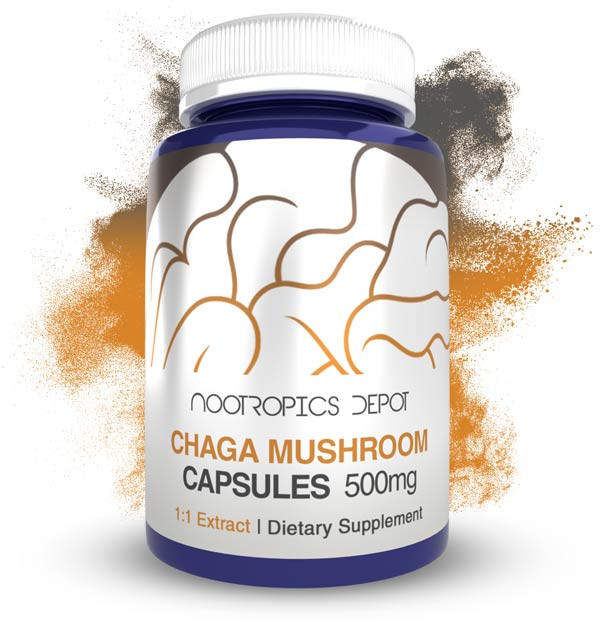
7.Nootropics Depot Chaga Capsules
The cheapest way onto this page, with seven signed lot certificates published on the product listing — the same welcome habit that put Nootropics Depot’s tremella at #4. Every batch is tested through independent labs for heavy metals, microbials and pesticide residues, and you can open the reports. For a wild-harvested material like chaga, where what grows on a birch tree in one forest is not what grows on another, batch-level testing is more than a nicety.
The same dose arithmetic applies as with their tremella: 500 mg per capsule against Real Mushrooms’ 1,000 mg, at the same 8% beta-glucan floor. Take two and you’re at $0.67 a serving, which is more than Real Mushrooms charges for the same amount of material. The sticker is lower; the value depends entirely on how you dose it.
One thing we’d flag as a miss: the page carries no oxalate or kidney caution anywhere, despite chaga being the highest-oxalate product in this whole comparison. Real Mushrooms addresses that directly in its own FAQ, and on that specific point it’s the more responsible listing of the two. Please read the kidney note on the pick above before you buy either one, and see chaga’s oxalate risk and the published case reports in full.
Read the full analysis
What we could and couldn’t verify: the $19.99 price for the 60-count is confirmed in the page’s own structured data. A 180-count is offered but its price is loaded by JavaScript and isn’t in the source, so we haven’t printed one. Servings per container aren’t stated; we derived 60 from the 500 mg serving and the capsule count. The listing describes the material as a concentrated extract but names neither a method nor a ratio.
Not a like-for-like swap: Nootropics Depot’s chaga powder is dual extracted, which produces a different actives profile from Real Mushrooms’ hot-water extract — so the two formats aren’t interchangeable even within the same brand, and neither is simply a cheaper version of the other.
Who it’s for: you, if you want chaga, you want to be able to check a certificate, and you’d rather spend twenty dollars than thirty-five finding out whether it suits you.
Commission may apply · never affects rankings
Shop With Confidence
How to Read Any Skin or Longevity Mushroom Label
Skin and longevity is the aisle where mushroom marketing gets loosest, and six checks will carry you through almost all of it. None of these require a chemistry degree — they’re just the questions the good brands have already answered on the page.
On certificates of analysis — including our own partner’s
The single most useful thing a brand can give you is a signed, lot-numbered certificate you can open. Nootropics Depot does this on every product page, one certificate per batch. Real Mushrooms — the brand we recommend most on this page and earn commission from — publishes a product-specific third-party report too: each of the tremella capsule, tremella powder, Ergo+ and chaga listings carries an SGS analysis report in a “3rd Party Testing” panel, signed by an SGS staff member and dated, covering microbials, heavy metals and glucan content. What it doesn’t do is publish per lot: one dated report per product, as an on-page image, rather than a certificate you can match to the batch code on your bottle. There is also a single brand-level certification portal link, identical across all of those products — that one is not product-specific and shouldn’t be mistaken for a certificate. Per-lot coverage is the gap we’d like to see closed. Our guide to how to read a mushroom supplement COA explains what one should contain.
Two smaller notes from the same review. A comparison module reading “guaranteed >30% beta-glucans” appears verbatim on the tremella, chaga and Ergo+ pages, contradicting each product’s own panel (10%, 8% and 15%) — it’s a template row in a brand-versus-brand table rather than a product claim, and we haven’t used it. And a science module on all three of those pages states that every batch of a fourth product is lab-verified for beta-glucan content, which looks like boilerplate left in place. Neither is dishonest; both are the kind of thing worth checking against the panel yourself.
Where we have to declare an interest
The best-known source for the “fruiting body good, mycelium-on-grain bad” argument is a 2015 industry white paper by Jeff Chilton. It is not peer reviewed, its sample sizes were tiny, and the comparison extracts were the author’s own product. Chilton co-founded Real Mushrooms — the brand we recommend above and earn commission on — with his son Skye, and his company Nammex supplies its ingredients; Real Mushrooms’ own quality page confirms it uses Nammex extracts. We are relying on a fruiting-body argument whose most-cited source is the supplier of the product we make money from. You should know that.
The direction of the argument does hold up in independent work — a 2017 US Pharmacopeial-affiliated analysis found only 5 of 19 retail reishi supplements matched their labels — but the specific percentages are not independently established. And the thesis is narrower than it’s usually stated: Real Mushrooms now sells a mycelium product itself, defending it as liquid-culture mycelium separated from its growing medium and freeze-dried rather than mycelium-on-grain. That’s a fair distinction, and it shows the real objection was always to grain and starch rather than to mycelium as such. Fruiting body versus mycelium-on-grain, explained goes through all three categories. Full details of how we handle this are in our affiliate disclosure.
Independence & Method
How We Chose & How We Score
AMT Scores here are the average of three axes, fixed before we looked at any price: label transparency (does the brand publish verifiable, checkable numbers — and can you download the lab report?), evidence behind it (how strong is the human literature for the ingredient, honestly graded), and value & buyer fit (cost per serving of disclosed material, and how many readers the product genuinely serves). Where two products tie, the higher score on the axis that decides the page wins — evidence between the two tremella-and-ergothioneine picks, transparency between the two at 4.2.
Why nothing here scores above 4.4. Our top lion’s mane pick scores 4.8. Nothing on this page can, and that’s deliberate rather than harsh: the evidence axis caps it. No ingredient here has independent human evidence that an oral supplement improved a skin outcome. Tremella and chaga have no oral skin trial of any kind. Ergothioneine has exactly one — 80 women randomized, 77 analyzed, over 12 weeks — funded by Hokuto Corporation, with three authors on the company’s payroll. One industry-funded trial is not a literature, and it is not enough to lift the evidence axis. We searched PubMed and the Cochrane Library on 22 August 2026 for randomized trials of oral tremella or Inonotus obliquus with a dermatological outcome and found none; the same search for ergothioneine returns that single 12-week trial and nothing else. Run those searches yourself — and if the answer changes, we will update this page. The strongest human skin evidence for tremella is topical; ergothioneine’s human literature is genuinely interesting but is mostly about uptake, a mortality association and one small cognitive pilot, with that lone industry-funded study on skin; chaga has no human clinical trial of any kind, for any outcome, from a literature of more than 400 papers. A page that scored these like lion’s mane would be lying to you about the state of the field.
Two things we owe you about our own data. First, our 48-product label transparency study contains no rows for the Real Mushrooms tremella products or for Ergo+ — its only tremella row is FreshCap’s, and it has no ergothioneine rows at all — so our figures for the two lead products here rest entirely on live label verification done on 22 August 2026. Second, that same study found Real Mushrooms to be the most expensive of the six brands we measured, at a $0.74 median against a study-wide median of $0.67. Read that alongside the study’s own limitation: at each product’s largest available pack the brand ranking changes, and Real Mushrooms moves from most expensive to mid-field. We recommend them anyway, on disclosure and dose density — but you are not getting the cheapest option, and we would rather say so than let you find out later.
Advanced MycoTech earns affiliate commissions from some links in this guide, but placement is never for sale: rankings are locked by the criteria above before any revenue consideration. Every product fact was verified against the manufacturer’s own label or product page before publishing, and re-verified at every update. Where a number could not be verified we wrote “not disclosed” rather than a flattering assumption — which is why extraction ratio is blank on all seven picks. Read our full editorial policy and affiliate disclosure.
Your Questions, Answered
FAQ
What is the best mushroom supplement for skin?
Based on our comparison of species verification, active-compound disclosure, testing evidence and price per serving, the best mushroom supplement for skin in 2026 is Real Mushrooms Organic Tremella Extract Capsules — an organic hot-water fruiting-body extract giving 1,000 mg per serving with 100 mg of beta-glucans declared on the panel, at $0.58 a serving. One honest caveat that applies to every product in this category: no randomized trial has tested an oral tremella supplement for a skin outcome in people, so we ranked on what brands disclose rather than on skin results nobody has.
Does tremella actually do anything for skin?
For the capsules and powder on this page — swallowed — that has not been demonstrated in people. The oral evidence is in mice: an 8-week study where animals given tremella polysaccharide held onto skin hydroxyproline — the standard marker for collagen content — and hyaluronic acid better than untreated controls. Applied topically there is real human evidence: in a placebo-controlled study of 20 volunteers, a gel containing 10% tremella extract moisturized significantly better than the identical gel without it, at every measurement out to three hours. A 2023 review in Archives of Dermatological Research reaches the same conclusion independently — the work so far is laboratory and animal models, and clinical research is still needed. Tremella is inexpensive and was well tolerated in the one oral human trial that exists — 75 adults over 8 weeks — and it is genuinely interesting chemistry. Just buy it with clear eyes about where the research has reached.
Is tremella really “nature’s hyaluronic acid”?
It’s an analogy about how the molecule behaves, not a statement of what it is. Hyaluronic acid is a chain of two repeating sugars, N-acetylglucosamine and glucuronic acid. Tremella’s signature polysaccharide is glucuronoxylomannan — a mannose-backbone polymer that shares exactly one of those sugars and contains no N-acetylglucosamine at all. Both are large, negatively charged, water-loving polymers, and that real similarity is the honest basis of the comparison. What the phrase should not do is borrow the credibility of oral hyaluronic-acid trials, because those tested a different molecule.
What is ergothioneine and is it worth taking?
It’s an amino acid derivative made in nature almost only by fungi, which is why mushrooms are far and away the richest dietary source. What makes it interesting is that your body has a dedicated transporter for it — it absorbs it, holds onto it, and excretes less than 4% of an oral dose in urine. Higher blood levels track with lower mortality in a 21-year study of 3,236 people, though ergothioneine was also the strongest single marker of a health-conscious diet in that data, so it may be flagging the eating pattern rather than doing the work. Worth taking if you find that genuinely interesting; not worth taking because someone promised you an outcome.
How much ergothioneine should you take a day?
Human studies have clustered between 5 and 25 mg a day, and EFSA has separately assessed synthetic L-ergothioneine as safe at up to 30 mg a day for adults. Real Mushrooms Ergo+ gives 10 mg per capsule, which is under the 25 mg used in the single 12-week skin trial — the industry-funded one, with no independent replication — and matching it would take 2.5 capsules a day, about $1.46. Purified isolates from other brands offer 30 mg per capsule far more cheaply per milligram, without the mushroom matrix. Follow the label serving of whatever you buy, and if you’re pregnant, nursing or taking medication, check with your clinician first.
Is chaga bad for your kidneys?
Chaga is very high in oxalates, and there are three published case reports of oxalate nephropathy in people taking it. The pattern in all of them is the same: grams of raw powder per day, taken for months to years and, where a motive is recorded, to self-treat a diagnosed illness. One man reached end-stage renal disease on 3 g daily for four years then 9 g daily for one, with no prior kidney problems; researchers measured his own powder at 14.2 g of oxalate per 100 g. Those intakes are many times a label serving, so this is a dose problem rather than a trace-exposure one, and a 1 g label serving sits far below anything in those reports. A 2026 rat study in J Korean Med Sci tested intakes extrapolated from these cases and found oxalate crystal deposition and tubular injury only in the high-dose group; the standard-dose group did not show them. That is a reason to stay at the label serving, not a guarantee. And kidneys aren’t the only concern: chaga has documented interactions with blood thinners and with diabetes medication too. If you have any kidney condition, reduced kidney function, a history of kidney stones, you take high-dose vitamin C, or you take an anticoagulant or a blood-sugar medication, speak with your doctor before taking chaga at all — and nobody should be taking it by the spoonful.
Which mushroom is best for longevity?
On the strength of the human research, ergothioneine — and it’s not close. It has verified human uptake and retention, a dedicated transporter, a 21-year prospective cohort associating higher blood levels with lower overall mortality, and a one-year human pilot that produced a clean safety record. All of that is association and early-stage work rather than proof, and its lifespan data is in male mice and nematodes. But compared with chaga, which has never been tested in a human trial for any outcome, it’s the only ingredient in this category with a literature worth reading.
How long should you give one of these before deciding?
The human trials that exist on these ingredients ran for weeks to months — 8 weeks for tremella and cognition, 12 weeks for the ergothioneine skin study, a year for the ergothioneine pilot. Treat your first bottle as the trial period rather than expecting anything in a fortnight, and take it at the same time each day so consistency isn’t the variable. Nothing here is a stimulant and nothing here works on a timescale you’d notice by Thursday.
Your First Bottle
How to Get Started
Picking the right bottle is most of the work, and you’ve just done it. Here’s how to give it a fair run once it arrives.
Educational information, not medical advice. Tremella has clean but very short human safety data — the longest oral trial we can find ran 8 weeks, and there is no pregnancy or breastfeeding data in either direction. No documented interactions is not the same as none.
The Bottom Line
You’re Ready to Choose
Skin and longevity is the corner of this category where the marketing has run furthest ahead of the research — and now you know exactly where the line sits. Real Mushrooms Organic Tremella Extract Capsules are the best overall choice for 2026: organic hot-water fruiting-body extract, a full gram per serving, a printed beta-glucan number and NMR species verification, at $0.58 a serving. Ergo+ is the pick if you want the ingredient with the most interesting human literature, and it prints the milligram figure that lets you compare it to the studies. The Longevity Pack is a verified 25% off if you wanted all three of its products anyway, Nootropics Depot is where to go if a downloadable certificate matters most, and chaga is worth having on the shelf only once you’ve read the kidney note.
One rule to take with you, and it works far beyond this page: buy from brands that state the species, the part of the organism, the extraction method and a real active-compound number — and treat a downloadable, lot-numbered certificate as the gold standard rather than a bonus. Every pick above clears the first bar. Real Mushrooms publishes a signed, dated third-party report on each product page, which is more than most brands do; only the two Nootropics Depot picks publish a certificate for every lot, and we’ve told you which. If you’d like the wider view across every species and goal, our flagship guide to the best mushroom supplements is the place to go next.
20% OFFOur link gifts you 20% off at Real Mushrooms — tap “Redeem Offer” and it auto-applies at checkout.
